Families with young children often discover that the rhythm of a resort does not match the rhythm of their own days. Breakfast service ends just as a toddler wakes from a late nap; dinner starts when the baby should be in bed; a fussy six-year-old turns down every buffet dish. A self-catering apartment, with a kitchen and a fridge, solves many of those problems at a stroke, and in Grenada it can also cost less than a hotel suite of similar size.
It is not right for every family. Self-catering means shopping, cooking and washing up on holiday, and many apartments have no pool attendant, no restaurant and no one to call when the air conditioning fails at midnight. This guide sets out when an apartment works better than a resort for families in Grenada, where to look, and the checks that keep the arrangement relaxing rather than a chore.
Why families choose apartments
Space is the first reason. For the price of a one-bedroom suite at a beach hotel, a family can often rent a two-bedroom apartment in the south of the island with a living room, a kitchen and a balcony. Children can nap in their own room in the afternoon heat while parents sit outside, and bedtimes do not depend on a restaurant's opening hours. For families staying longer than a week, that difference adds up.
Food is the second. Being able to make a simple breakfast at the time the children wake, keep milk and snacks cold, and cook plain pasta for a child who will not eat anything else takes pressure off the whole day. Many families combine the two: cooking breakfast and some lunches in the apartment, and eating out for dinner a few times a week at the many restaurants around Grand Anse, Morne Rouge and Lance aux Epines. That way the children get familiar food and the adults still try local dishes such as oil down, callaloo soup or fresh fish.
When a resort is still the better choice
Very short stays. For a long weekend or a four-night trip, the time spent shopping and cooking takes a larger share of the holiday, and a resort's ready-made routine is easier.
Families who want a kids' club. Only larger resorts run supervised children's programmes. If a couple of child-free hours each day is the main aim, an apartment will not deliver it unless you arrange a babysitter.
Parents who want a genuine break from cooking. If the person who cooks at home wants a week off, an all-inclusive or half-board plan may be worth the extra cost for everyone's sake.
No car. Many apartments in the south are a walk from shops and beaches, but some are up steep hills or in quiet residential areas. Without a hire car, shopping trips depend on taxis or route buses, which are manageable but harder with small children.
Calm water on the doorstep. Beachfront resorts on Grand Anse or near Point Salines put a gentle beach steps from the room. Apartments are more often a short walk or drive from the sea.
Where to look on the island
Most family-friendly holiday apartments sit in the south-west, where the island's calmer beaches, supermarkets, restaurants and the airport are close together. Grand Anse and Morne Rouge offer the easiest access to sheltered beaches, with apartment buildings and small complexes set back from the sand or on the slopes above. Lance aux Epines and the neighbouring southern peninsulas are quieter and more residential, with some apartments and cottages near small beaches and marinas. Calliste, near Point Salines, is handy for the airport and for beaches on that side of the peninsula.
Further north and east, apartments are fewer and journeys longer, though some families like the quieter feel of St David's or the countryside of St Andrew's. With young children, the south-west is generally the most practical first base, simply because everything a family needs is within a short drive. Wherever you look, check the real distance to the nearest beach and supermarket on a map rather than trusting a listing's "close to the beach", and note whether the walk involves a busy road without pavements.
Apartment hotels: the middle ground
Between a full resort and a private apartment sits a type of property common in Grenada: the apartment hotel or suite hotel. These are small to mid-sized properties, often family-run, where each unit has a kitchen or kitchenette, but there is also a reception desk, daily or regular housekeeping, a pool and sometimes a bar or restaurant on site. Several such properties operate around Grand Anse, Morne Rouge and the southern peninsulas.
For families, apartment hotels often combine the best of both arrangements. Parents can cook breakfast and keep milk cold, children have space, and someone is on hand when the air conditioning stops working or a cot is needed. They are usually cheaper than full-service beach resorts, though facilities are simpler. When comparing, ask how often housekeeping visits, whether the kitchen is a full kitchen or a kitchenette with a two-ring hob, and whether the restaurant is open every day of the week.
What to check in a family apartment listing
Listings for apartments vary widely in detail. Before booking, confirm these points with the owner or manager, ideally in writing:
- Air conditioning in each bedroom, not only the main one, and whether electricity is included or metered separately.
- The kitchen equipment: a full-size fridge, a hob and oven or microwave, a kettle, and enough pans and plates for your family.
- Whether there is a washing machine, or a laundry service nearby.
- A cot and high chair on request, and whether there is a charge.
- Pool details, if there is one: depth, fencing and whether it is shared with other units.
- Water supply arrangements, such as a storage tank or pump, which help if mains water is interrupted.
- Who to contact for problems, and whether someone is on site or nearby day and night.
- Security: locks on doors and windows, lighting and whether the complex is gated.
Shopping and cooking without spending the holiday on it
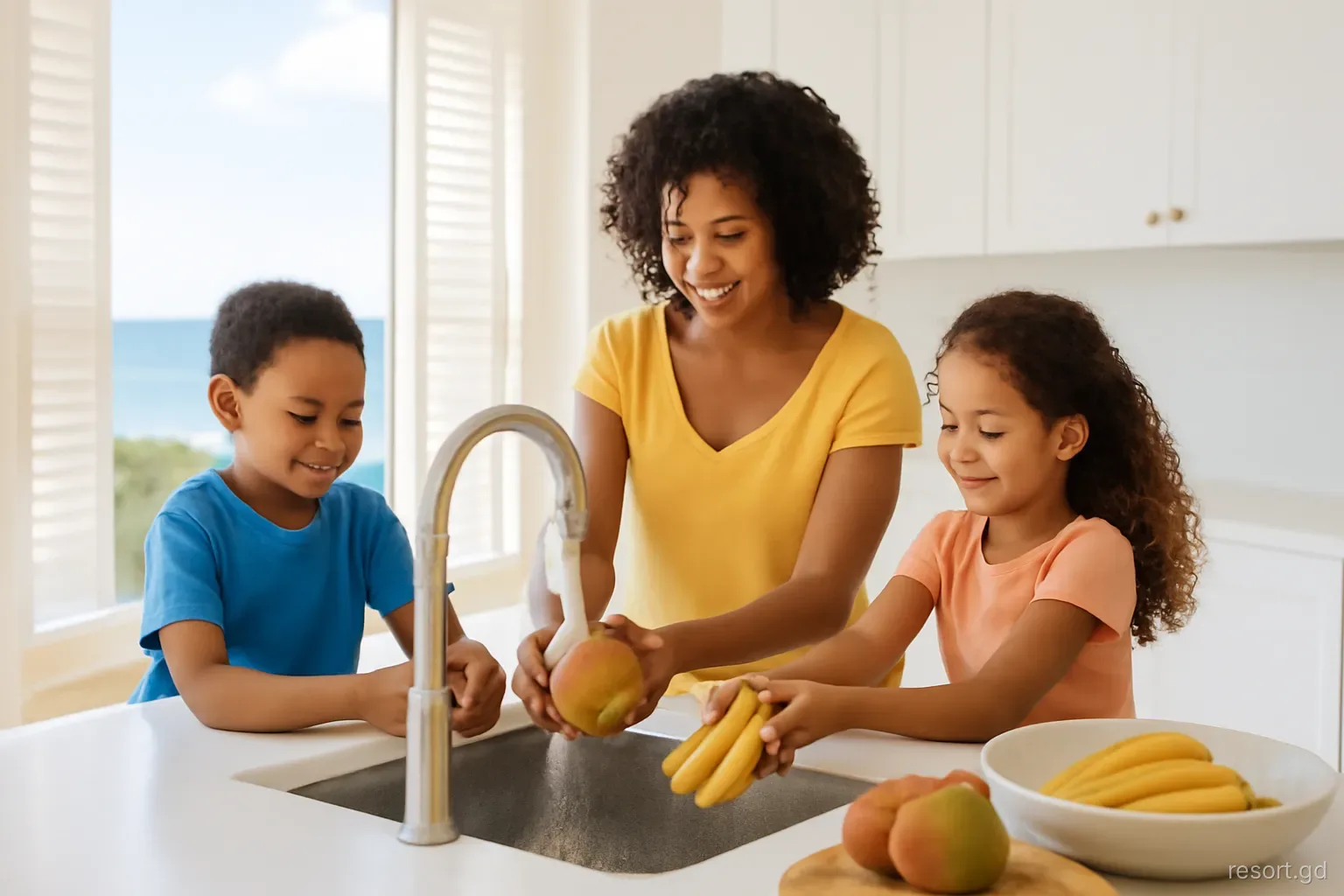
Supermarkets in the south, including those around Grand Anse and the main shopping areas, stock most of what a family needs, from cereals and pasta to nappies and long-life milk. Imported products cost more than at home because of shipping and duties, while local produce is often good value: bananas, mangoes, papayas, sweet potatoes, christophene and fresh fish change with the season. Saturday morning at the market square in St George's is the liveliest time to buy fruit and vegetables, and children usually enjoy the colour and noise.
Keep cooking simple. Plan a few easy meals for the week, buy staples on the first day, and top up fresh items as you go. Many families find that eating the main meal at lunchtime, when children are hungriest, and having a light supper suits the heat. Bakeries and roadside stalls selling roti, bakes and fresh juice make easy lunches on beach days. Supermarket opening hours are shorter on Sundays and public holidays, so stock up the day before.
A small cool box is worth buying or borrowing on the first day. It keeps drinks and fruit cold on beach outings, saves money on snacks bought at beach bars, and lets children have familiar food wherever the day takes you. Freeze a couple of water bottles overnight to use as ice blocks.
Mistakes families make with self-catering
The most common mistake is underestimating the shopping on arrival day. After a long flight, with tired children, a supermarket trip is the last thing anyone wants. Ask the owner whether a welcome pack of basics can be left in the fridge, even at a charge, or plan a simple first evening at a restaurant nearby. The second mistake is choosing an apartment on the strength of its price without checking how it works without a car. Steep hills, no pavements and evening darkness from around 6.30pm make walking with children harder than it looks on a map.
Families also overlook the noise and heat in some older buildings, where only the master bedroom has air conditioning and children sleep in a warm second room. Ask specifically. Finally, apartments have no front desk to absorb small problems, so agree in advance how quickly the manager will respond to a broken fridge or a power cut. A responsive manager matters as much as the view.
Frequently asked questions
Are holiday apartments cheaper than hotels in Grenada?
Often, especially for families. A two-bedroom apartment can cost similar to or less than a hotel suite, and cooking some meals reduces food costs. Imported groceries are expensive, so savings depend on how much you cook and what you buy.
Which area of Grenada is best for a family apartment?
The south-west, around Grand Anse, Morne Rouge, Lance aux Epines and Calliste, is the most practical. It has calm beaches, supermarkets, restaurants and the airport close together, which matters with young children.
Is a car needed when self-catering in Grenada?
Not always, but it helps. Some apartments are within walking distance of shops and beaches, while others are on steep hills or in quiet areas. Without a car, taxis and route buses work, though they are less convenient with small children.
Do Grenada supermarkets sell familiar foods for children?
Yes. Supermarkets in the south stock cereals, pasta, long-life milk, snacks and baby products, many of them imported from North America and Europe. Prices are higher than at home, and particular brands may be missing, so bring essentials.
Can a family combine self-catering with resort facilities?
Some resorts and hotels offer suites or apartments with kitchens, letting families cook breakfast while using the pool, beach and restaurant. This hybrid often suits families who want flexibility without giving up resort conveniences.