For families with young children, the swimming pool is both the best part of a Grenada holiday and the biggest risk. Drowning is fast and silent, and toddlers are drawn to water. Resort pools in the Caribbean, including Grenada, are rarely staffed by lifeguards, and many villas have pools a few steps from the living room with no fence at all.
None of that is a reason to avoid a pool; it is a reason to choose the property with care and set a few house rules. This checklist covers what to look for when booking, what to check on arrival, and the habits that keep children safe in hotel pools, private villa pools and the increasingly common plunge pools attached to suites.
Why pool safety needs more thought in Grenada
Visitors from the United Kingdom, North America and Europe are often used to public pools with lifeguards, depth markings and strict regulations. Standards in the Caribbean vary between properties. Large resorts may have shallow children's pools, clearly marked depths and staff nearby during the day, but many do not post lifeguards, and signs commonly state that guests swim at their own risk. Small hotels and villas may have a single pool with a sudden drop from shallow to deep, and pool areas that are open to the garden at night.
Villas are where the gap is widest. Many of the island's rental villas, from Lance aux Epines to Westerhall and the hills above Grand Anse, were designed for adults and built with infinity edges, steep steps and no barrier between the terrace and the water. Some owners can install a temporary pool fence on request; many cannot. Plunge pools in luxury suites present the same problem in a smaller space: a beautiful feature for couples, a hazard for a crawling baby who can open a sliding door.
The practical answer is to treat every pool on the trip as unsupervised unless the property tells you otherwise in writing, and to choose accommodation where the layout helps rather than hinders. A ground-floor room that opens straight onto a pool is convenient for older children and stressful for parents of a toddler; a room one level up, with the pool in view from the balcony, can be the better choice.
Questions to ask before you book
Photographs show the view, not the safety features. Before paying a deposit for a hotel or villa, ask:
- Is there a separate, shallow children's pool, and how deep is it?
- What is the depth at the shallow and deep ends of the main pool, and is the change gradual or sudden?
- Are there lifeguards, and if so, at what hours?
- For villas and suites with private pools: is the pool fenced, can a fence or alarm be supplied, and can doors to the pool area be locked from the inside?
- Is the pool area lit and closed at night, and are gates self-closing?
- Are there life vests, rings or other buoyancy aids available, or should you bring your own?
- Is the pool surround non-slip, and are steps into the water wide and shallow?
- How far is the pool from the rooms, and can it be seen from your terrace?
On arrival: a ten-minute safety walk
Before the swimsuits come out, walk the pool area with the children and check the details that matter. It takes ten minutes and sets the tone for the week:
- Locate the shallow end and the point where it becomes deep. Show children where they can stand and where they cannot.
- Check the gates and doors. In a villa, see whether sliding doors to the pool deck lock and whether locks are within reach of a child. Use them every time.
- Look for drains and filter inlets. They should have intact covers; report any that are loose or broken and keep children away from them.
- Find the buoyancy aids and the first-aid kit, and note the emergency number, 911, and the property's own contact for help.
- Agree the rules aloud: no swimming without an adult, no running on wet tiles, no diving in shallow areas, and nobody enters the pool area alone.
- Decide who is the "water watcher" for each session, and make it one named adult at a time.
Habits that keep children safe all week
Assign a water watcher. The most effective rule is that one adult watches the water without a phone, a book or a drink, and hands over explicitly when they need a break. At group villas with several families, drowsy afternoons and long lunches are the riskiest moments, because everyone assumes someone else is watching.
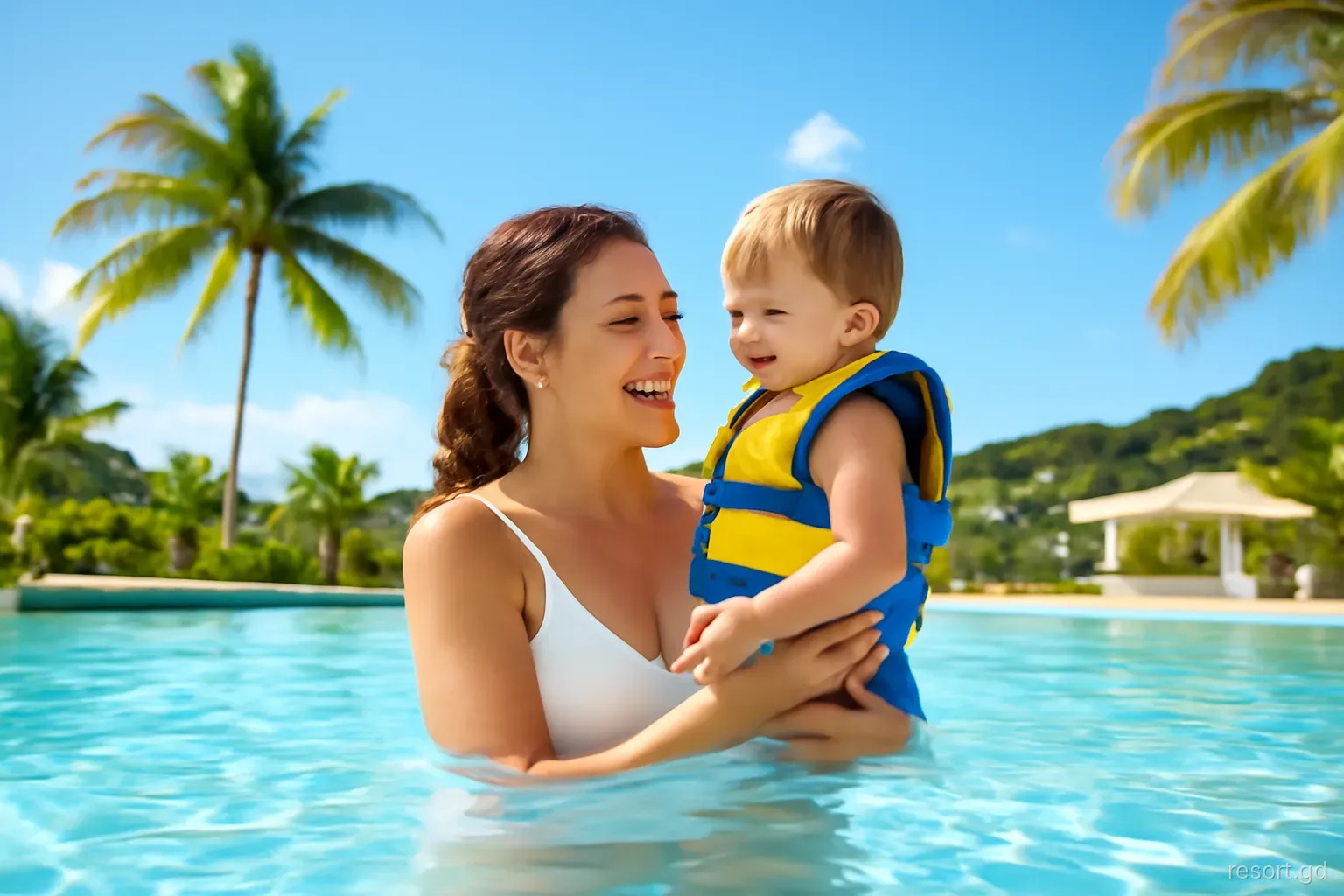
Use proper buoyancy aids. Swim vests approved to a recognised standard (such as US Coast Guard or European CE ratings) are more reliable than inflatable armbands, which can slip off. Bring your own if possible, as hotels may have only a few, or none in children's sizes.
Mind the evenings. Pools are dark, cool and tempting after dinner, and the light fades quickly year-round close to the equator. Many incidents happen when children wander out while adults are inside.
Watch the sun as well. Grenada sits at around 12 degrees north, and the sun is fierce between late morning and mid-afternoon. Rash vests, hats, reef-safe sunscreen and shade breaks protect children from burns that can spoil a whole holiday.
Know the sea is different. Pool confidence does not transfer to the sea. Calm Caribbean beaches such as Grand Anse and Morne Rouge are generally gentle, but the Atlantic coast, including Bathway and La Sagesse in some conditions, has waves and currents that need far more caution.
Children's pools, splash areas and plunge pools
Where a resort has a dedicated children's pool, it is usually shallow enough for a young child to stand, sometimes with a splash area, fountains or a small slide. These are excellent for toddlers but they are not playpens. Children slip, older children play roughly, and a shallow pool can still be deep enough for a face-down fall. Stay within arm's reach of non-swimmers, and check whether the children's pool is fenced or opens straight onto the main pool, where the depth drops away.
Plunge pools deserve a separate plan. Many suites at Grenada's higher-end resorts have a small private pool on the terrace, often a step or two from the bed and screened from view for privacy, which also means nobody else will notice a child in trouble. With babies and toddlers, keep the sliding door locked and the key or latch out of reach, and consider asking the resort for a room without a private pool. For older children who swim confidently, a plunge pool is usually fine with an adult nearby, but set the same rule as for the main pool: no swimming without an adult present.
Mistakes parents make with pools on holiday
The biggest mistake is relaxing too much because the setting feels safe: a quiet villa, no strangers, a gated garden. Many drownings of young children happen at private homes, during moments when adults believe the child is indoors. The second is relying on older siblings to supervise. A twelve-year-old enjoying the pool with friends is not watching a toddler in the way an adult is, and should not be expected to.
Parents also underestimate how slippery tiled surrounds become after rain, and how often children climb to dangerous points such as low walls next to infinity edges or steps down to rocks. In a villa with a cliff-edge pool, check what lies beyond the edge. Finally, alcohol and supervision do not mix well. On a holiday when rum punch is included in the rate, agree in advance which adult is on duty and keep their glass to water. None of this has to dampen the holiday; a clear routine, set on day one, means everyone can relax afterwards.
Frequently asked questions
Do Grenada resorts have lifeguards at their pools?
Some larger resorts have staff near pools during the day, but many hotels and nearly all villas do not have lifeguards. Signs often say guests swim at their own risk. Ask the property before booking, and always plan to supervise children yourself.
Can a villa in Grenada supply a pool fence?
Some villa owners or managers can install a removable fence or a pool alarm on request, but many cannot. Ask when enquiring and get confirmation in writing. If no fence is possible, consider a different villa when travelling with toddlers.
Is it worth bringing your own swim vests to Grenada?
If your children need buoyancy aids, bringing well-fitting approved vests is the safest option. Hotels and villas may have few or none in small sizes, and local shops may not stock the type or size you need.
Are plunge pools safe for families with small children?
Plunge pools attached to suites are often unfenced and reachable through sliding doors. With a crawling baby or toddler, they require constant vigilance and locked doors. Some families choose a room without a private pool to avoid the risk.
Is sea swimming safer for children than pool swimming?
Not necessarily. Calm west-coast beaches such as Grand Anse are gentle, but waves, currents and boats add risks a pool does not have. Supervise closely in both, and avoid the rougher Atlantic beaches with young children unless conditions are clearly calm.