
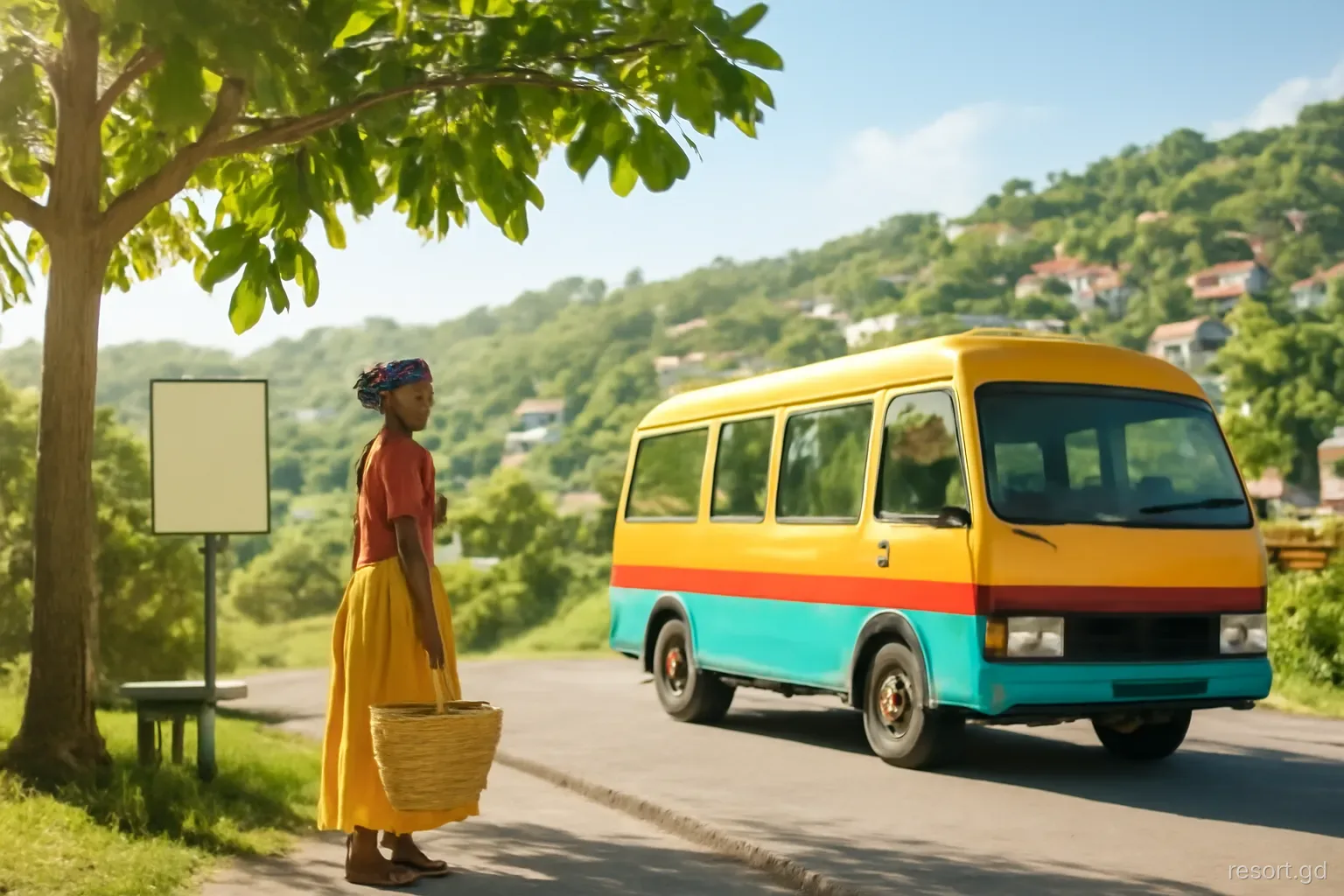
The charm of a rural lodge in Grenada is distance from the busy south-west. The catch is the same distance. Once you are up a hillside in St David, near Sauteurs in St Patrick or on the Atlantic side of St Andrew, getting to a beach, a restaurant or a waterfall needs a plan. Plenty of guests manage happily without driving; others find a car essential. Which group you fall into depends on the lodge, the itinerary and how comfortable you are on narrow, winding roads.
This guide sets out the realistic options: route buses, taxis and private drivers, hire cars, and the hybrids most visitors end up using. It covers arrival from the airport, day trips, evenings, and the mistakes that cause the most frustration, so you can decide before you book whether a particular lodge suits the way you want to travel.
Route buses: cheap, frequent, and daytime only
Grenada's public transport is a network of privately owned minibuses running set routes, mostly radiating from the bus terminal in St George's. Each route has a number displayed on the bus, and you can flag one down anywhere along the road by raising a hand, then ask the conductor or tap the roof to get off. Fares are low, a few EC dollars for most journeys, paid in cash, ideally in small notes.
For a rural lodge, buses work best if the property is on or close to a main road served by a route, such as the coast roads through St David, Grenville, the west coast through Gouyave and Victoria, or the north around Sauteurs. Travelling across the island often means changing in St George's or Grenville. Buses are lively, sometimes loud, and an excellent way to see everyday life.
The limits are timing and terrain. Services are frequent in the morning and afternoon, thin out by early evening, and are much reduced on Sundays and public holidays. Lodges up steep side roads may be a long walk from the nearest stop. Buses are not practical with large luggage, so they suit day trips rather than arrival and departure.
Taxis and private drivers
Taxis are widely available at the airport, in St George's and at the main hotels, but rarely cruise rural roads. In the countryside you book ahead, usually through your lodge, which will often have a driver it trusts. Fares for common journeys between the airport and the main areas have long been set by agreement with the taxi association and the tourism authorities; ask for the current rate before you set off and confirm whether it is quoted in EC or US dollars.
Hiring a driver by the hour or the day is a popular choice for island tours. Many drivers are knowledgeable about history, spices and plants, and will stop at viewpoints, estates and roadside stalls. Agree the route, the duration and the price in advance, including waiting time at waterfalls or lunch stops.
Drivers in rural areas often have other work and may not be available at short notice, particularly early in the morning or on Sundays. Booking a day ahead, and confirming the evening before, avoids disappointment. For departure, allow generous time to reach the airport: from the north or the Atlantic side the journey can take well over an hour, and traffic around St George's and Grand Anse builds at the start and end of the working day.
For arrival, a pre-booked transfer is strongly recommended if your lodge is rural. Flights often land in the afternoon or evening, and finding an unfamiliar hillside property in the dark after a long journey is stressful. Your host can usually arrange a driver to meet you at Maurice Bishop International Airport.
Hiring a car: what to know
Driving permit. A foreign licence is not enough on its own; you need a local temporary driving permit, which car hire companies issue or arrange when you collect the car. There is a fee, so confirm the current cost and what documents to bring.
Driving on the left. Grenada drives on the left. Many hire cars are right-hand drive, but some imported vehicles are left-hand drive, which takes extra care at junctions and when overtaking.
Roads. Main roads are paved but narrow, winding and often without pavements or lighting. Expect pedestrians, dogs, goats and buses stopping without warning. Mountain roads through Grand Etang have tight bends and can be wet.
Vehicle choice. A compact car is fine for most of the island. If the lodge track is steep or rough, ask whether a higher vehicle or four-wheel-drive is advisable.
Navigation. Phone navigation works for main routes but can misjudge side roads and village tracks. Ask your host for directions from a clear landmark, and save the property's location before you leave mobile coverage.
Insurance and inspection. Check what the insurance covers, especially tyres and windscreen, photograph the car at pick-up, and keep the hire company's contact details handy.
Evenings: the gap in the plan
Evenings are where rural stays without a car most often go wrong. Buses largely stop after dark, taxis need booking, and driving unfamiliar mountain roads at night is best avoided even if you have a car. If the lodge does not serve dinner and there is no restaurant within walking distance, every evening meal becomes a logistical exercise.
Before booking, ask three things. Does the lodge cook dinner, and how much notice is needed? Is there anywhere to eat within a safe walk on a lit or quiet road? Can the host arrange a driver for evenings out, and roughly what does that cost? A property with a good kitchen removes most of the problem; one that relies on guests driving out for dinner suits only those with a car and the confidence to use it.
Fridays are a common exception worth planning around. The fish fry in Gouyave draws people from across the island, and some drivers run groups there and back. For other nights out, such as dinner around Grand Anse, booking a driver for the round trip is safer than navigating back to the hills after a glass of rum punch.
Common mistakes, and how to avoid them
Most transport problems on rural stays come from a handful of assumptions.
- Assuming taxis will be available on demand in the countryside. Book in advance through the lodge, especially for early mornings and evenings.
- Driving from the airport to a remote lodge after dark on the first night. Arrange a transfer or schedule arrival in daylight.
- Relying on buses on a Sunday or public holiday, when service is limited.
- Forgetting cash. Bus fares, small shops and many drivers expect EC dollars.
- Picking a lodge far from everything without a car, then spending a fortune on taxis. Compare the cost of a week's car hire with likely taxi fares before deciding.
- Underestimating journey times. Distances look short, but winding roads mean an average speed well below what visitors expect. Allow extra time, particularly for flights.
Matching transport to the lodge
A sensible approach is to choose transport and lodge together. If you want to stay remote and explore widely, hire a car for at least part of the stay and get the local permit sorted on arrival. If you prefer not to drive, choose a lodge on or near a bus route, with meals on site, and budget for a driver on two or three days for the excursions that buses cannot reach.
Many visitors mix the two: a driver for the airport run and for one full-day island tour, buses for a trip into St George's or Grenville, and a hire car for a couple of days in the middle. It is flexible, keeps costs reasonable and avoids night driving.
Whatever you choose, tell your host your plans. Rural hosts in Grenada are usually generous with advice about which roads to avoid after rain, which bus stops are closest and which drivers are reliable. That local knowledge is the most useful transport resource you will have.
Frequently asked questions
Is a car needed to stay at a rural lodge in Grenada?
Not always. If the lodge provides meals and sits near a bus route, many guests manage with buses and an occasional driver. For remote lodges or wide-ranging itineraries, a hire car for at least part of the stay is usually more practical.
How do route buses work in Grenada?
Privately run minibuses follow numbered routes, mostly from the St George's terminal. Flag one down anywhere along the route, pay a small cash fare and tell the conductor where to stop. Services are limited in the evening and on Sundays.
Does a visitor need a local driving permit in Grenada?
Yes. A foreign licence must be accompanied by a temporary local permit, which car hire companies normally issue or arrange on collection. A fee applies, so confirm the current cost and requirements when booking the car.
Can taxis be booked to collect guests from a hillside lodge?
Yes, but book ahead, usually through the lodge, since taxis rarely cruise rural roads. Agree the fare and currency before starting the journey, and allow extra time for early-morning airport runs.
Is it safe to drive at night in rural Grenada?
Roads are narrow, winding and mostly unlit, with pedestrians and animals on the verges. Night driving is best avoided by visitors unfamiliar with the routes, particularly over the mountains. Booking a driver for evenings out is a common solution.